

Small Trees for Gardens
Every garden, however modest its footprint, deserves a tree. A well-chosen specimen anchors a planting scheme, draws the eye upward and provides seasonal interest that no border plant can quite replicate. The good news is that you don’t need acres of space, there are dozens of smaller species that fit comfortably into domestic gardens without outgrowing their welcome.
At Deepdale, we grow and supply semi-mature trees to the professional market across the UK and small ornamental varieties are among the most popular requests we receive. Here’s what you should know before choosing yours.
Why Size Matters When Choosing Garden Trees
The most common mistake people make is choosing a tree based on how it looks in year one rather than year ten. A tree labelled ‘small’ typically reaches a mature height of four to eight metres — still perfectly manageable for most gardens, but not worth planning for. Think about canopy spread as much as height, consider the root zone relative to boundaries and structures and think about how much light the tree will cast in summer.
Soil type, aspect and exposure also influence how a tree performs long-term. Most small ornamentals are reasonably adaptable, but matching the variety to your conditions will always give better results.
Take a look at the trees we offer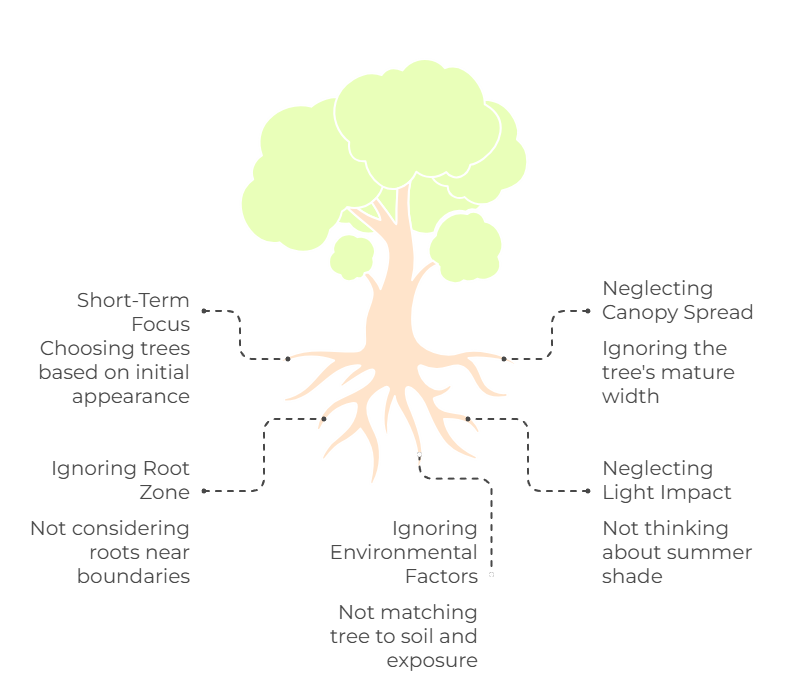
Popular Small Trees for UK Gardens
Below are some of our most-recommended varieties, each well-suited to the British climate and reliable in residential settings.
- Amelanchier lamarckii (snowy mespilus) — a genuine all-rounder with delicate white spring blossom, summer berries that birds love and vivid orange-red autumn colour. Reaches around 6m at maturity
- Malus (ornamental crab apple) — available in dozens of cultivars, offering spring flowers in white, pink or deep red and decorative autumn fruit. A dependable choice for wildlife-friendly gardens
- Prunus (ornamental cherry) — Prunus ‘Kojo-no-mai’ and similar compact cultivars deliver spectacular spring blossom in a tightly branching form. Ideal for smaller plots
- Acer griseum (paperbank maple) — grown as much for its peeling, cinnamon-coloured bark as its foliage. Slow-growing, elegant and striking in winter when other trees look bare
- Cercis siliquastrum (Judas tree) — produces vivid pink flowers directly on the branches and trunk in late spring, before the leaves appear. Excellent in a warm, sheltered spot
- Sorbus aucuparia (rowan) — a native species with strong wildlife value, white spring flowers and heavy clusters of orange-red berries from late summer through autumn
The Advantage of Semi-Mature Specimens
Planting a semi-mature tree rather than a bare-root whip means you get immediate visual impact and a more established root system from the outset. For residential gardens, this is particularly valuable — you’re not waiting years for the tree to make its presence felt.
At Deepdale, all of our trees are grown with care and chosen for quality. Whether you’re a landscaper specifying a single focal specimen or a designer planning a whole scheme, get in touch, we can help you find the right variety in the right size.
