
Ginkgo biloba - Maidenhair tree
Ginkgo biloba is a large, deciduous tree which has a narrow habit and grows up to 30m. It has a resistance to pests, diseases, pollution and many soil conditions making it an excellent specimen for urban planting.

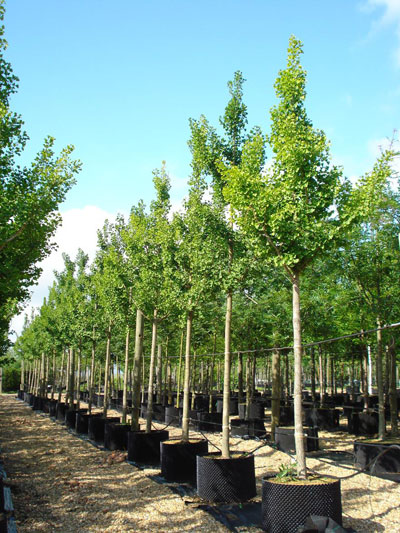


Bright green, fan shaped leaves emerge in Spring and later they turn brilliant yellow giving a beautiful Autumn show.
Interestingly, Ginkgo biloba is neither a broadleaf or a conifer and has its own division, Ginkgophyta. Because it has no close living relatives, it is also the only tree in this division.
Often know as the ‘living fossil tree’, fossil records show that species closely related to today's Gingko have existed for over 200 million years across Europe, Greenland and the USA. Scientists believe that it was the glaciers covering most of the northern hemisphere which reduced its population and distribution to a small area of China.
Ginkgo biloba is the national tree of China and some specimens planted in temples are claimed to be over 2,500 years old.
Ginkgo biloba is available from Deepdale Trees as a standard or multi-stemmed tree.
FACT: When the atomic bomb dropped on Hiroshima, six Ginkgo trees growing within 2km survived. Although slightly burnt, they recovered quite quickly and are still alive today.
Plant Profile
Name: Ginkgo biloba
Common Name: Maidenhair tree
Family: Ginkgoaceae
Height: Approx. 25-30m, though some individual plants in China are over 50m
Demands: Well watered and well drained soil
Flowers: No flowers
Foliage: Fan shaped, two lobed leaves with veins radiating from the petiole.
Bark: light to greyish brown. Ridges become deeper as the tree matures.
Deepdale Trees are expert growers and wholesalers of the UK's finest semi-mature trees and shrubs
Contact Us